Play Video
Play Video
Play Video
In B2B ecommerce, most conversations start with platforms, features, and user experience. But anyone who has lived through a real implementation knows the truth:
Integration, not the storefront, is where B2B ecommerce projects succeed or fail.
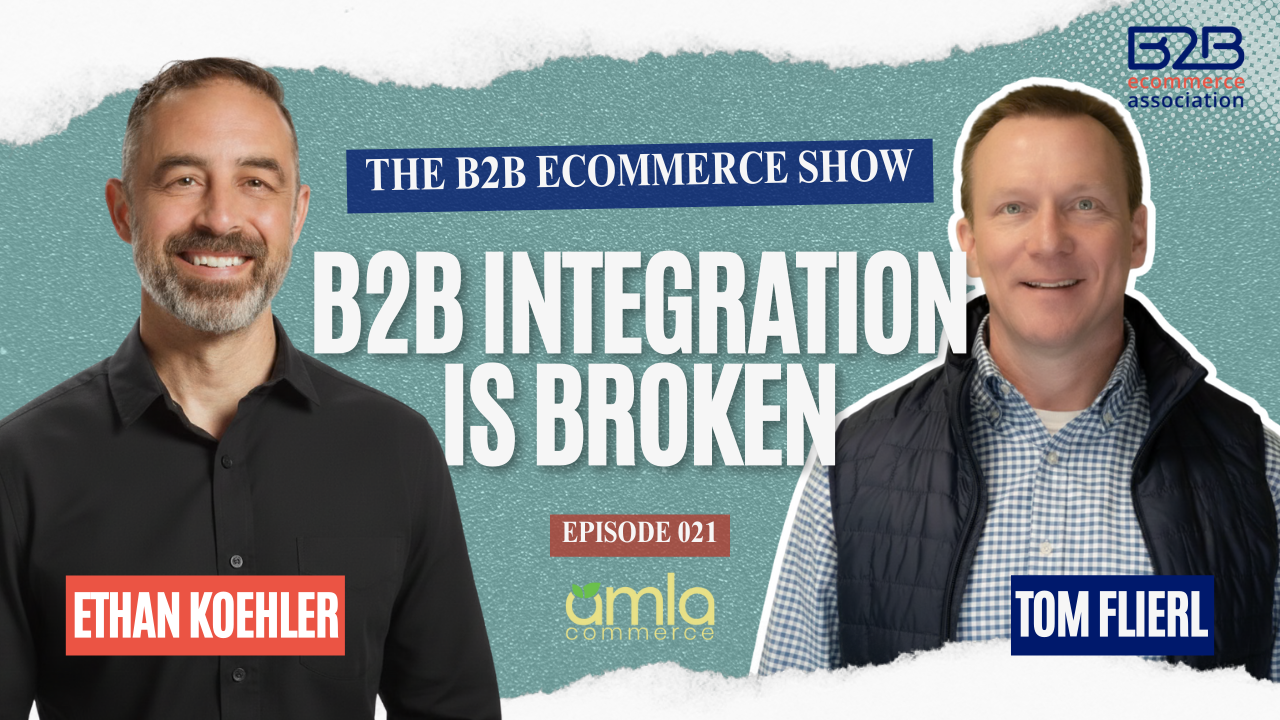
That reality was the focus of a recent episode of The B2B Ecommerce Show with Tom Flierl and Ethan Koehler from Amla Commerce, the company behind the Znode platform. Together, they explored why integrations remain the highest-risk area in B2B ecommerce, how ERP complexity has increased, not decreased, and why Znode’s new Commerce Connector represents a meaningful shift in how the industry approaches integration.
What emerged was a clear theme:
B2B ecommerce is not a website problem. It’s a systems orchestration problem.
Why Integrations Are the Highest-Risk Part of B2B Ecommerce
According to Tom Flierl, integrations consistently represent the greatest concentration of cost, risk, and time in B2B ecommerce projects. In many mid-market implementations, 30–40% of the total project effort is spent on integration work alone.
There are several reasons for this:
- Many manufacturers and distributors still run legacy ERPs that were never designed to support modern digital commerce
- Mergers and acquisitions have created environments with multiple ERPs, not just one
- Data must be orchestrated across ERP, PIM, CRM, WMS, and other systems
- Business rules, pricing models, and customer relationships vary widely
Unlike B2C, where ecommerce platforms were often built with minimal back-office dependency, B2B commerce requires constant, bidirectional data exchange. ERP systems remain the operational heart of the business, and often the biggest constraint.
Why “Out-of-the-Box” Integrations Rarely Work in B2B
A common market assumption was challenged, the belief that ecommerce integrations must be either fully custom-built or entirely out of the box.
Ethan Koehler explained that B2B reality lives somewhere in between.
Every B2B organization has unique:
- workflows
- customer hierarchies
- pricing rules
- contractual relationships
- approval processes
Because of that complexity, customization will never disappear entirely. The real opportunity is to reduce how much custom code is required, isolate it to specific areas, and make it easier to manage and maintain over time.
Historically, integrations break down not only because of technical challenges like data mapping and real-time synchronization, but also because of coordination across multiple vendors, internal teams, and external partners. Integration failures are as much organizational as they are technical.
Introducing Commerce Connector: A Different Approach to Integration
Znode’s response to this problem is Commerce Connector, a native integration framework built directly into the Znode platform.
Rather than relying entirely on third-party middleware or scattered custom code, Commerce Connector acts as a central integration layer, offering many of the benefits of middleware while remaining deeply embedded in the ecommerce platform itself.
Key characteristics include:
- A single administrative interface to configure, monitor, and audit integrations
- Support for real-time APIs, scheduled jobs, and file-based exchanges
- Visibility into integration health, errors, and execution status
- The ability to integrate ERP, PIM, CRM, WMS, and other systems
For customers, this means integration is no longer hidden behind custom scripts or external tools. It becomes a visible, manageable part of the ecommerce platform.
What Is a “Data Exchange” and Why It Matters
At the core of Commerce Connector is the concept of a data exchange.
A data exchange defines:
- the source system
- the destination system
- the type of data being exchanged
- the frequency (real-time, scheduled, or on-demand)
- authentication and security
- field-level mappings between systems
Even something as simple as a product record rarely matches field-for-field across systems. Data exchanges formalize and standardize those mappings, making them reusable and easier to maintain as systems evolve.
This structure allows companies to scale integrations without rebuilding them from scratch every time a new system or workflow is introduced.
It’s Not Just ERP: The Full Integration Landscape
While ERP is often the most critical system, Tom and Ethan emphasized that Commerce Connector is designed to support any system that can expose data.
Common integrations include:
- ERP for pricing, inventory, orders, and customers
- CRM to synchronize accounts, opportunities, and sales activity
- PIM systems to manage product data as a source of truth
- WMS platforms for fulfillment and logistics
In many organizations, ecommerce sits at the intersection of customer data, product data, and transactional data. Commerce Connector acknowledges that reality and treats integration as a core capability, not an afterthought.
Supporting Sales Teams with a Unified View
One of the less obvious benefits of this approach is how it supports internal users, especially sales teams.
Znode’s role-based portals allow different users to see different data through a single interface. For example:
- sales reps can see CRM data alongside ecommerce activity
- open carts can trigger CRM opportunities
- account-level behavior can inform offline follow-up
This brings traditional sales and digital commerce closer together, rather than positioning ecommerce as a competing channel.
Solving the ERP Replacement and Consolidation Problem
A growing challenge in the market was highlighted: ERP consolidation.
Many manufacturers and distributors are reducing 10 or more ERPs down to a single system after years of acquisition-driven growth. When integrations are hard-coded directly into ecommerce platforms, ERP replacement becomes painful and expensive.
Commerce Connector changes that dynamic.
By abstracting integrations into a centralized framework, companies can:
- retire legacy ERP connections
- point data exchanges to new systems
- reduce rework during ERP transitions
This flexibility is especially valuable during multi-year ERP modernization initiatives.
A Modern Architecture Built for B2B Scale
The conversation also explored Znode’s broader architectural decisions.
Rather than traditional shared-database SaaS, Znode operates as distributed SaaS:
- each customer has a fully segregated database
- updates are delivered in a controlled, testable manner
- APIs power all front-end experiences
This model addresses a common enterprise concern: performance and data isolation at scale. A distributor with millions of SKUs should not be impacted by another customer’s workload.
At the same time, the platform avoids the six-month upgrade cycles common in monolithic systems, allowing customers to adopt new capabilities without massive disruption.
Who Is Znode Built For?
According to Tom Flierl, Znode is a strong fit for three primary profiles:
- Program- and formulary-driven businesses
Industries like uniforms, healthcare, promotional products, and foodservice where ecommerce supports many branded storefronts with unique catalogs and rules.
2. Mid-market to enterprise distributors
Especially those facing performance limits, large catalogs, or ERP-driven constraints in HVAC, electrical, plumbing, and industrial distribution.
3. Manufacturers enabling distributors and dealers
Manufacturers using ecommerce to support multi-brand catalogs, global markets, dealer enablement, and SEO-driven product exposure.
Across all three, the common thread is complexity, and the need for flexibility without fragility.
The Bigger Takeaway for B2B Ecommerce Leaders
The conversation with Tom Flierl and Ethan Koehler reinforces a reality many teams learn the hard way:
B2B ecommerce success depends less on features and more on how well systems work together.
Integrations are not a one-time task. They are an ongoing capability. Platforms that treat integration as a first-class citizen, visible, configurable, and resilient, give manufacturers and distributors a real advantage.
As ERP environments grow more complex and customer expectations continue to rise, the companies that win will be the ones that reduce friction between systems, not just between pages.
That is what modern B2B ecommerce demands, and where the industry is heading next.
Contact Tom and Ethan | Amla Commerce