Play Video
Play Video
Play Video
In B2B commerce, orders rarely fail at checkout. They fail after checkout.
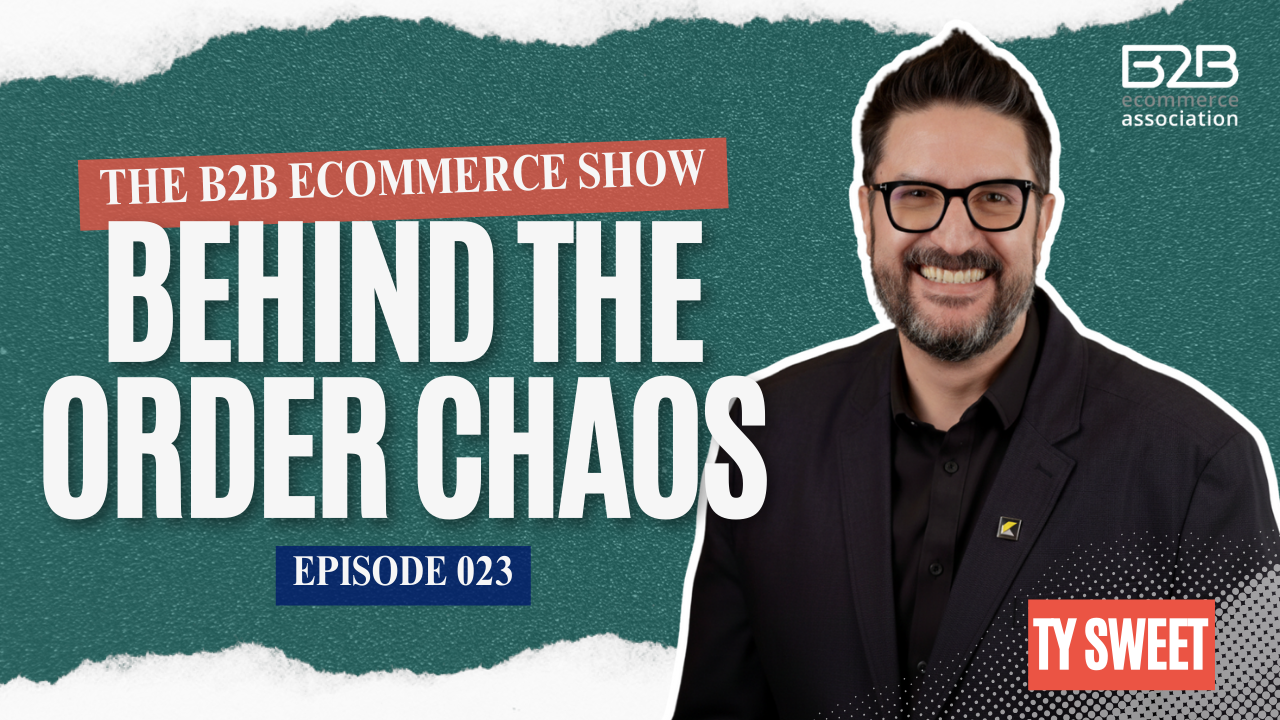
That reality framed a recent episode of The B2B eCommerce Show with Ty Sweet, Senior Technical Marketing Engineer at KIBO and widely known as “The Voice of KIBO.” With a background spanning solutions engineering, enablement, and platform education, Ty specializes in breaking down complex commerce concepts into practical, operational understanding.
The episode focused on a single, deceptively simple truth: B2B orders are inherently messy, and pretending otherwise is what creates chaos behind the scenes.
The Hidden Complexity Behind “Simple” B2B Orders
A B2B order may look straightforward in a cart, but operationally it can involve:
- dozens of line items
- multiple warehouses across regions
- dropship vendors
- partial backorders
- contract pricing
- customer-specific fulfillment rules
- split shipments
- multiple ERPs due to acquisitions
Historically, this complexity was handled informally. Branch managers and sales teams understood customer priorities, and inventory decisions were often made through personal knowledge, phone conversations, and long-standing relationships rather than systems.
Digital commerce removed humans from the middle of many transactions, but it didn’t remove complexity. It exposed it. When automation replaces judgment without replacing the underlying logic, things break. Customer service is flooded, warehouses receive conflicting instructions, and sales and finance begin pointing fingers.
This is where modern Order Management Systems (OMS) become foundational.
What an OMS Actually Does, and Why It Exists
Ty defines OMS in simple terms:
- Ecommerce platforms take the order
- Order management systems decide what happens next
Once a customer clicks place order, OMS becomes the brain of fulfillment. It determines where the order should be fulfilled from, whether it should be split or consolidated, how inventory is allocated, how to minimize shipping cost and time, and how to honor customer-specific rules.
In small, single-warehouse operations, this logic is trivial. In modern B2B organizations with complex distribution networks, it becomes mission-critical.
Order Orchestration: The Brain of Fulfillment
Throughout the conversation, the discussion repeatedly returned to the concept of order orchestration.
Order orchestration is the logic layer that evaluates inventory availability across locations, customer preferences, cost tradeoffs, carrier options, and dropship scenarios. A single order with 50 line items might be fulfilled through:
- three warehouse shipments
- two manufacturer dropships
- one backordered item shipped later
OMS handles this automatically and in real time using predefined business rules rather than improvised decisions. This orchestration is what prevents a “simple” order from turning into an operational fire drill.
ERP vs OMS: Where Companies Get Confused
One of the most common mistakes B2B companies make is trying to force their ERP to behave like an OMS.
Ty was clear about the distinction:
- ERP is the system of record for financial reconciliation, accounting, and reporting
- OMS is designed for real-time decision-making
ERPs operate primarily in batches, with inventory updates occurring every few hours. That delay makes real-time fulfillment decisions risky, especially when order volume spikes. OMS, by contrast, manages:
- real-time inventory
- available-to-sell and available-to-promise
- inventory reserved in active carts
- future inventory tied to purchase orders
When companies overload ERPs with routing and orchestration logic, they create what Ty described as a “Frankenstein ERP”, expensive, fragile, and difficult to scale. The most effective organizations simplify by letting ERP do what it does best and allowing OMS to handle complexity natively.
Why Real-Time Inventory Is No Longer Optional
Many organizations believe they have real-time inventory because they make API calls to their ERP. That approach breaks down at scale.
When thousands of users are browsing, adding items to carts, requesting availability, and placing orders simultaneously, ERP APIs become bottlenecks. Worse, they don’t account for inventory already reserved in carts or tied to pending orders.
OMS solves this by making inventory stateful and contextual. Inventory in carts is recognized, future inventory is factored in, and promises are based on reality rather than snapshots. The result is fewer oversells, fewer backorders, and a far better customer experience.
Personalizing Fulfillment by Customer and Contract
B2B commerce is governed by contracts, and fulfillment often needs to be personalized by customer. Different customers may require:
- consolidated shipments
- specific fulfillment locations
- delayed delivery windows
- approval workflows
- pricing and freight rules
OMS allows these rules to be defined once and executed automatically. Instead of relying on manual intervention, the system routes each order according to the customer’s agreed terms, every time and at scale.
Why OMS Becomes More Important as Automation Increases
As order intake becomes more automated, the importance of OMS increases.
As AI begins to ingest EDI orders, interpret emailed POs, accept conversational orders, and automate procurement, human checkpoints disappear. That makes strong rules and guardrails more important, not less.
OMS becomes the single place where fulfillment logic lives, priorities are enforced, and exceptions are handled consistently. Without it, automation simply accelerates failure.
KIBO’s Full-Stack Approach to Commerce
KIBO’s platform reflects this reality by treating OMS as a core component rather than an add-on. Their architecture supports:
- B2B, B2C, and D2C models
- ecommerce and OMS independently or together
- API-first integrations with ERP, WMS, CMS, and CRM
- partner-led implementations for complex environments
This flexibility allows organizations to adopt OMS first, ecommerce first, or both, depending on where pain is greatest.
AI, Agentic Commerce, and the Future of Order Management
While the episode focused on fundamentals, Ty shared a forward-looking view of AI’s role in commerce. AI agents will assist buyers in navigating complex catalogs, help internal teams create product content, optimize order routing strategies over time, and automate repetitive operational tasks.
But AI does not replace OMS, it depends on it. AI works best when rules are clear, data is trusted, and workflows are structured. OMS provides that foundation.
Where Companies Should Start with OMS
Ty offered practical guidance for organizations evaluating OMS. Start with pain:
- excessive split shipments
- rising shipping costs
- inventory inaccuracies
- customer service escalations
- ERP performance issues
Then ask where logic is being forced into ERP that doesn’t belong, where humans are compensating for system gaps, and what breaks when volume spikes.
For many organizations, OMS isn’t an enhancement, it’s overdue infrastructure.
The Bigger Takeaway for B2B Leaders
The conversation closed with a historical observation: the earliest purpose-built B2B commerce platforms were designed around order management, not storefronts.
That insight still holds. In modern B2B commerce, checkout is easy, fulfillment is hard, and complexity lives after the cart. Organizations that treat OMS as foundational rather than optional build resilience, scalability, and trust with customers.
Because in B2B, orders aren’t simple, and the systems behind them shouldn’t pretend they are.
Contact Ty | KIBO Commerce