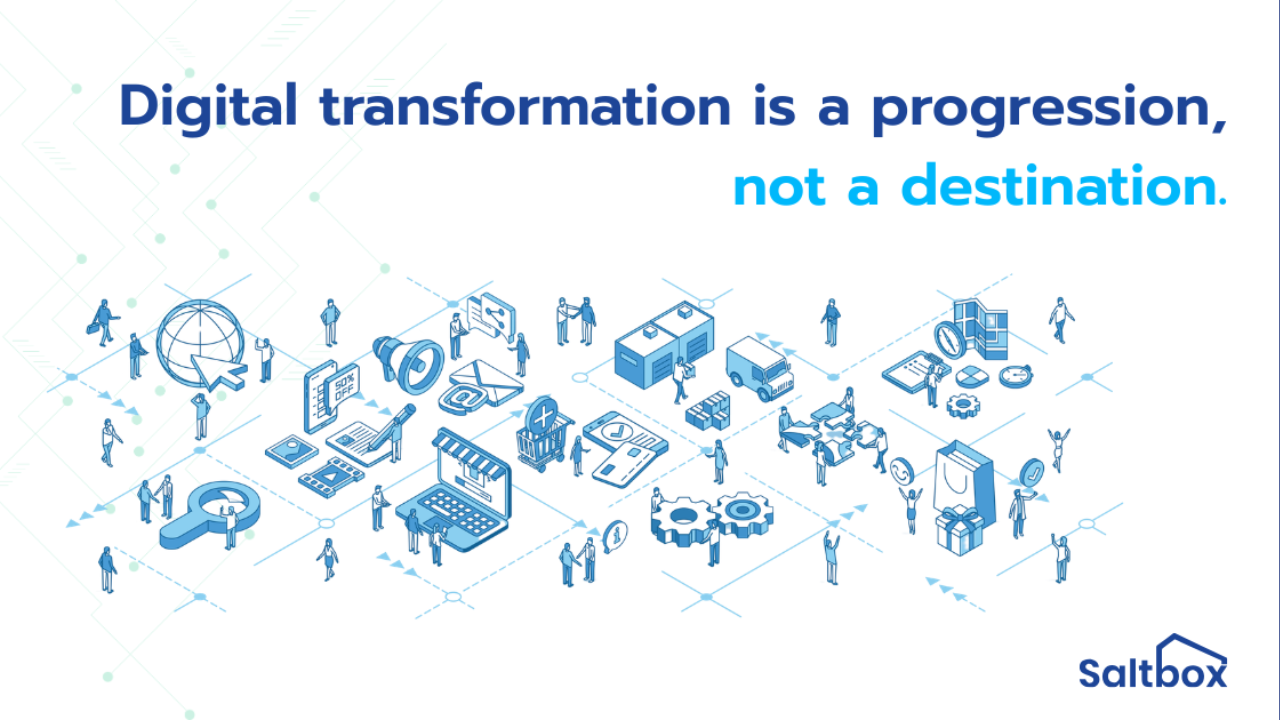
If there is one thing I have learned after decades in this ecosystem, it’s this: Digital transformation is not a finish line. It is a progression.
Too often, companies treat transformation like a destination. A future state they will “arrive at” once the system is live, the platform is deployed, or the roadmap is complete. But real transformation does not work that way. It unfolds in stages. It compounds. And it is deeply contextual.
There is no universal blueprint.
There is only what makes sense for your business right now.
Digital maturity looks different for every organization.
A manufacturer modernizing distributor ordering is not solving the same problem as a med-device company that is rethinking field service. A national distributor consolidating pricing logic is not on the same path as a regional player building its first unified customer view.
And that is exactly the point.
Transformation should be defined on your terms. It should align to your supply chain complexity, your customer expectations, your channel relationships, and your operational realities. Not someone else’s roadmap.
Every Maturity Stage Should Create Real Business Value
There is a misconception that only the innovative stage of digital maturity drives competitive advantage. That is simply not true.
Foundational capabilities create value.
Differentiated capabilities create value.
Innovative capabilities create value.
The key is alignment.
Foundational capabilities might mean centralizing product data, implementing structured pricing logic, or connecting ERP and CRM for better customer visibility. That alone can reduce friction, improve forecasting accuracy, and increase operational efficiency.
Differentiated capabilities might include account based pricing automation, role based buying experiences, or advanced approval workflows across branches and distribution centers.
Innovative capabilities could mean AI driven demand forecasting, intelligent recommendations, or predictive service models.
Each stage drives outcomes when it solves a real business problem.
Transformation is not about chasing the most advanced capability. It is about activating the next best capability. And we say it all the time because it is true: You cannot boil the ocean.
Focus on the Next Best Capability
The companies that make real progress do not try to leap to the end state vision in one motion. (That’s a quick way to waste money, cause internal chaos, and build technical debt.)
They identify the next capability that will unlock measurable impact:
- Reduce order entry errors
- Improve inventory management
- Shorten approval cycles
- Increase distributor satisfaction
- Improve forecasting accuracy
- Drive margin improvement through better pricing controls
That is how maturity builds. Not through grand declarations but through disciplined execution. After all, it’s grains of sand that make up a beach.
Salesforce Supports Maturity Based Transformation by Design
One of the reasons we believe so strongly in the Salesforce platform is because it is designed for progression. You do not have to replatform every time you mature.
- You can start with Sales Cloud to unify pipeline and pricing.
- Layer in Service Cloud to support post sale execution.
- Extend into Commerce to enable digital self service for distributors or contractors.
- Connect Order Management for visibility and orchestration.
- Activate Data Cloud to unify behavioral and transactional insights.
The platform is built to expand with you. This is critical in B2B environments where supply chains are layered, pricing is negotiated, and buying committees are complex.
When your data is connected and your workflows are shared, maturity does not just progress. It compounds.
Maturity Compounds When Systems Are Aligned
Transformation becomes real when sales, service, commerce, and operations operate on a shared data foundation. Alignment is not a technical milestone. It is a business inflection point.
Reliable demand signals strengthen forecasting. Clear visibility improves order execution. Shared context elevates customer conversations. Manual workarounds fade, operational risk declines, and scalability becomes practical instead of theoretical.
The power is not in any single capability, but in how each one reinforces the next. A disciplined product catalog improves commerce. Stronger commerce generates better demand data. Better data sharpens planning. Stronger planning reduces fulfillment friction and increases distributor satisfaction, driving retention and long term revenue stability.
Compounding maturity is not a collection of projects. It is connected capability reinforcing itself over time.
The Real Outcome: Operational Confidence
The true measure of digital transformation is not how modern your technology stack looks on a slide. The real measure is operational confidence.
Confidence that:
- systems scale as demand increases.
- pricing structures hold up under complexity.
- data stands up in executive decision making.
- teams adapt when markets shift.
- the supply chain flexes without collapsing into manual workarounds and reactive firefighting.
Operational confidence is maturity in action.
Digital transformation is not about innovation for its own sake. It is about building executional strength that drives adaptability, resilience, and sustained growth.
Define Transformation on Your Own Terms
The most successful B2B organizations we work with do not ask, “How do we become digitally transformed?”
They ask:
- What capability do we need next?
- Where is friction costing us margin?
- Where are our channel partners frustrated?
- What data are we missing to make better decisions?
- What operational risk keeps us up at night?
Transformation is not about boiling the ocean. It is about progressing with intention.
Step by step.
Capability by capability.
Outcome by outcome.
Because when maturity compounds, confidence follows. And that is when digital transformation stops being a buzzword and starts becoming a competitive advantage.
Practical Questions to Assess Your Digital Maturity
If you are evaluating your own progression, start here.
Foundational Alignment
- Is your customer, product, pricing, and inventory data unified across systems?
- Can sales, service, and operations see the same version of the truth?
- Are manual processes creating avoidable operational risk?
Differentiation
- Are you delivering role based, account specific buying experiences?
- Can you automate complex approval workflows without slowing down business?
- Do distributors and channel partners have visibility into order status and inventory?
Innovation
- Are you using predictive insights to guide forecasting and production?
- Can you identify margin leakage before it impacts profitability?
- Are your systems adaptable when new channels, products, or pricing models emerge?
- And perhaps the most important question: do you have operational confidence, or are you relying on heroics and workarounds?
Digital transformation is not a destination. It is a progression. The question is not whether you have arrived. It is whether you are advancing.