Play Video
Play Video
Play Video
For most of B2B, eCommerce adoption has followed a predictable arc: early skepticism, gradual experimentation, and then an accelerating push as digital-first competitors forced the issue. In industrial distribution, that arc has been slower than most. The sector has long relied on field sales, deep customer relationships, and a belief that complex technical products simply require a human conversation to sell.
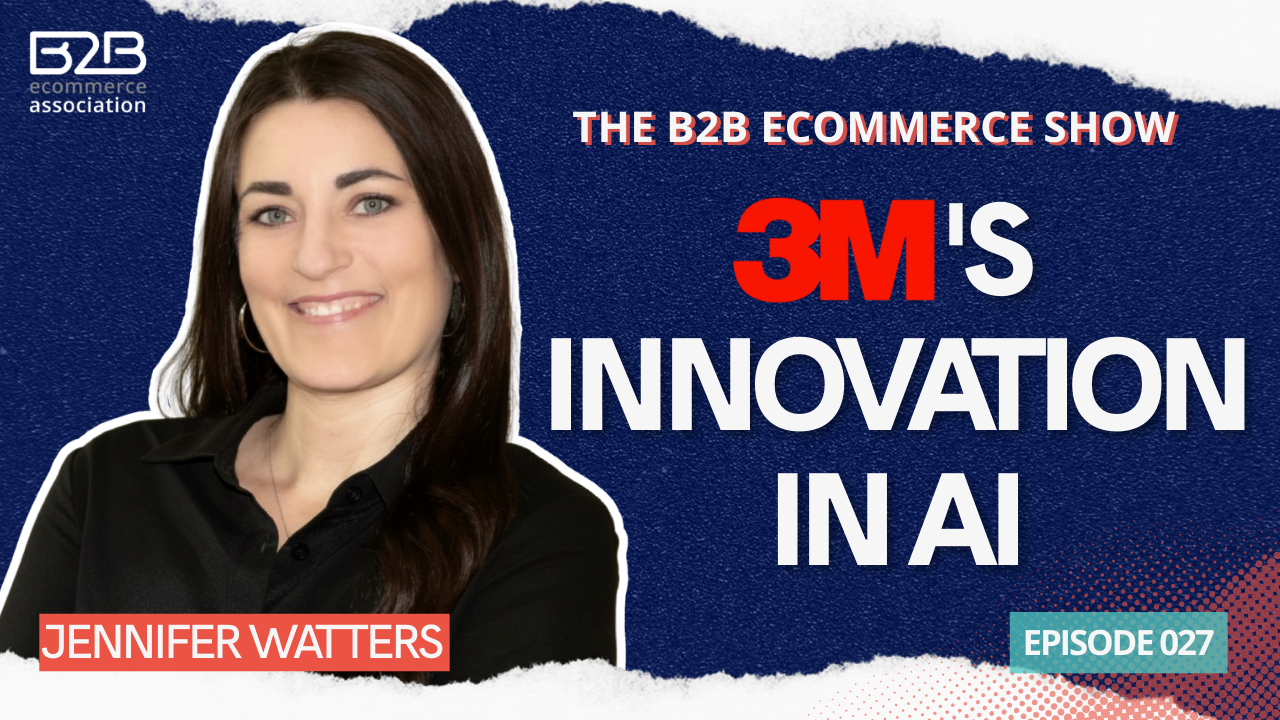
Jen Watters, eCommerce Marketing Supervisor at 3M, is working at the center of that shift. In a recent episode of The B2B eCommerce Show, host Sarah Falcon, SVP of Global Marketing at the B2B eCommerce Association, sat down with (https://www.linkedin.com/in/wattersjennifer/) to talk through what digital transformation actually looks like inside a global manufacturer, from AI tools in pilot to the daily work of helping industrial distributors grow their digital channels.
From Consumer to Industrial: A Career Built on Curiosity
Jen’s path to her current role is a good example of how eCommerce careers develop inside large organizations. She joined 3M in customer service, moved onto the Amazon account managing consumer brands including Post-it, Scotch, and Command, and then made the transition to the industrial side of the business, working with abrasives, industrial tapes and adhesives, and personal safety products sold primarily through industrial distributors.
“I originally wanted to go into nonprofit in college,” Jen said. “I couldn’t be more happy to be where I am now and thankful that I stumbled into it.” The pivot from consumer to B2B came through the Amazon account, where she worked with Amazon Business alongside the consumer side. “Working with Amazon Business was fascinating to me, and how the mix between consumer and business within one account can be different, and how you treat them almost as separate accounts within how you approach them from sales to marketing.”
That experience shaped her understanding of how a single channel partner can contain multiple buyer types with very different needs, a complexity that becomes even more pronounced in industrial distribution, where 3M’s channel partners each serve distinct end-user industries and their own layers of B2B customers.
The Industrial Digital Gap, and Why It’s Closing
Industrial distribution has historically operated on a traditional field sales model, and Jen is direct about what that means for eCommerce adoption. “Industrial just has not needed to be digital,” she said. “It’s been traditional field sales. Just with the sales model they have, it’s never needed to be digital and now everything’s moving that way.”
That shift is not incremental. As the B2BEA’s research on the evolution of distributors in the digital age makes clear, the pressure on industrial distributors to invest in digital platforms, product data quality, and customer-facing eCommerce capabilities is accelerating, driven by shifting buyer expectations, a younger workforce with digital-first purchasing habits, and competition from digital-native platforms.
Jen’s role is to help 3M’s channel partners navigate that transition. “If you want to remain competitive, you have to have a digital platform now,” she said. “Being able to educate our channel partners on how to grow with digital and be competitive in the industrial space has been a fun learning experience.”
Part of that education is internal. Helping 3M teams that do not come from a digital background understand what eCommerce requires of them, including product data quality, process mapping, and digital content, is as much a part of her work as managing external channel relationships.
Ask 3M: AI Applied to a Real Customer Problem
The most significant development Jen discussed is Ask 3M, an AI-powered digital assistant that 3M debuted at CES 2026. According to 3M’s announcement, Ask 3M is currently being piloted with engineers solving bonding design challenges using 3M’s portfolio of tapes and adhesives, powered by Amazon Web Services including Amazon Bedrock and AgentCore. The goal is to help customers move from problem to product recommendation significantly faster than the traditional model allows.
Jen described the use case clearly: “You can enter into it any question you have or a solution you may need. ‘I want to metal to a certain type of wood, in this temperature with this humidity.’ You can enter that in. It might give you a few different solutions to consider with adhesives versus tapes, which might be better. And then it’ll suggest some 3M products.”
Before Ask 3M, the answer to that question came from a field sales representative or a technical specialist, either at 3M or at the distributor. That model depends on the right person being available at the right time, something that becomes harder to scale as buyer expectations shift toward digital self-service. “Everything’s moving digital now,” Jen said. “So it’ll be at your fingertips now.”
Sarah Falcon framed the broader implication well: “That’s a really sophisticated solution to what I’m sure is a huge customer service problem because the amount of knowledge and understanding you need to have of 3M products as well as sort of all the products and materials out there is just like beyond, I mean, from an outsider perspective, having that knowledge in my head seems completely daunting.”
Jen confirmed the point, noting that even she, less than a year into her role on the industrial side, was still absorbing the depth of the portfolio. “For someone to be able to learn everything that we have to find a solution on their own would be a large challenge. So having this type of service available versus having to call or find someone in the field, especially this younger generation that’s coming up, they’re going to go to their phone or their computer first anyway.”
Ask 3M is planned to extend beyond its initial adhesive and tape focus, eventually reaching more of 3M’s product portfolio and becoming available to channel partners and their end users. The B2BEA’s own work on AI applications for distributors and manufacturers covers the landscape of where AI is creating real operational value in B2B, and Ask 3M is a strong example of what it looks like when a manufacturer applies AI directly to a known customer pain point rather than to internal efficiency alone.
AI in the Day-to-Day: How Jen Uses It at Work
Beyond Ask 3M, Jen talked through how she uses 3M’s internal AI tools in her own work. The applications she described are specific and practical: using AI to summarize meeting notes, to build process maps for internal presentations, and to translate technical or eCommerce-specific language into terms that non-digital teams can understand.
“I’m trying to lay out a process map,” she said. “We’re trying to explain, especially in eCommerce, a lot of it is educating internally what our current process is and how it needs to be more efficient and how they are involved in that process. And so where that comes in to be able to explain it better, a lot of people are visual. So being able to write out the steps, the very long process of how something is currently happening, it goes to this team and then it goes to this team, and how we need all of this in a system.”
She also uses AI to reframe her communications for different audiences. “Speaking digital, speaking eCommerce, speaking technology, they don’t always understand that where systems, the names of systems and the processes in the digital sense, you sometimes have to explain that differently. Then AI can totally help with that as far as just putting it in layman’s terms for a different team.”
That use case reflects something broader: AI is not just a productivity tool. For practitioners who operate at the intersection of technology and business, it is also a translation layer that helps digital teams communicate more effectively with the rest of the organization.
Staying Current in a Field That Keeps Moving
Sarah asked Jen how she stays on top of a field that changes quickly. Her answer reflects a combination of structured learning and immersive practice: newsletters from industry associations, channel partner webinars, market research from sources like Cleveland Research, and direct learning from the channel partners she works with daily.
“The B2B eCommerce Association I definitely learn from,” Jen said. “I read a lot of the articles and Justin’s podcast and things like that. That has been helping me a lot.” She also credits learning from her own sales team, who bring account-level insight that market research alone cannot provide.
The underlying theme is that staying current in B2B eCommerce requires active participation in a professional community, not just periodic reading. For practitioners at all levels, the B2BEA exists to support exactly that kind of continuous learning. You can explore the full podcast archive and related resources at The B2B eCommerce Show and follow the conversation on (https://www.linkedin.com/company/the-b2b-ecommerce-show).
What the Industrial Sector Can Teach the Rest of B2B
Jen’s story is a useful reminder that digital transformation does not look the same in every vertical. Industrial distribution presents specific challenges: deep technical product knowledge requirements, a buyer base that has historically depended on in-person sales relationships, and a digitization journey that is, in many organizations, still in early stages.
But it also presents a real opportunity. The companies that invest in digital shelf quality, in channel partner education, and in tools that replicate the knowledge of their best sales representatives at scale are building a competitive position that will be difficult to close once it takes hold. As the B2BEA’s research on reimagining sales in a digital-first world shows, the manufacturers and distributors that treat digital as a complement to their field sales model rather than a threat to it are the ones gaining ground.
Jen’s enthusiasm for that challenge comes through clearly. “Anytime I can talk about eCommerce and help people grow in their digital maturity is so exciting to me,” she said. “I get very passionate about it on calls. And I think people realize that because then they get excited about it and follow up.”
Listen to the Full Episode
This conversation with Jen Watters is available on The B2B eCommerce Show, the B2B eCommerce Association’s podcast. The show features practitioners, operators, and digital leaders from across the manufacturing and distribution world. Subscribe wherever you listen to podcasts, and follow the B2B eCommerce Association on (https://www.linkedin.com/company/the-b2b-ecommerce-show) for new episodes and related content.
For more on the topics covered in this episode, explore:
- The Evolution of Distributors in the Digital Age
- The AI Advantage: Elevating B2B Operations for Distributors and Manufacturers
- Reimagining Sales in a Digital-First B2B World
- 3M’s Ask 3M announcement (news.3m.com)