Play Video
Play Video
Play Video
For anyone who has spent time in B2B distribution, one truth becomes obvious very quickly: selling products online is not the same as doing business online.
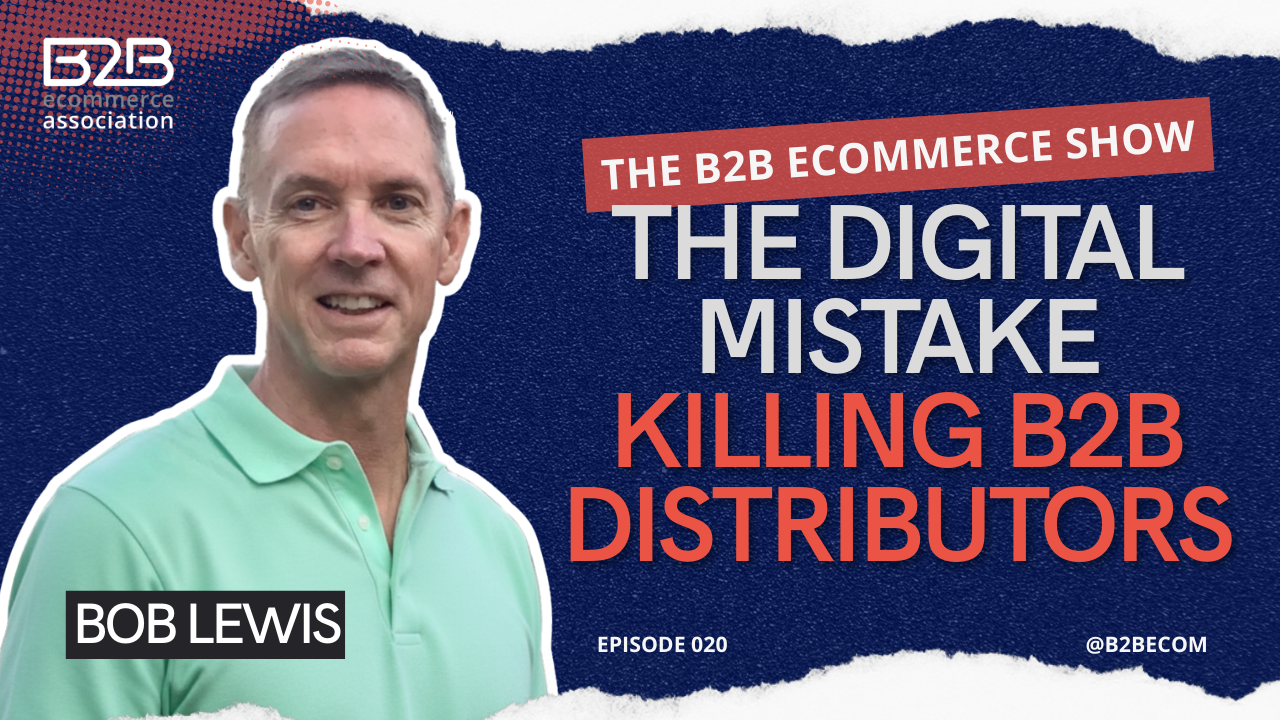
In this episode of The B2B Ecommerce Show, Bob Lewis, founder of Impaqx and one of the original architects behind modern product information management (PIM) and digital commerce strategies for wholesale distribution. What unfolds is less a typical interview and more a masterclass in how independent distributors can compete, and win, against national giants in a digital-first world.
Bob Lewis hasn’t just watched B2B ecommerce evolve. He helped build the foundation it stands on today.
From PIM Before It Had a Name to Powering Modern Distribution
Long before “PIM” became an industry buzzword, Bob Lewis was already solving the problem it was meant to address. His early work focused on what was then called a Data Content Integrator, helping distributors manage and normalize massive amounts of product data.
That work put him directly inside the world of wholesale distribution, supporting organizations like United Stationers, Johnstone Supply, and later Affiliated Distributors (AD), a buying and marketing group representing more than 1,500 independent distributors across industries such as industrial supply, HVAC, plumbing, electrical, and PVF.
What Bob quickly realized was that content, not price was the real barrier to ecommerce adoption for independents.
National distributors could afford teams of 100 people dedicated to product data. Independents couldn’t. Without intervention, digital commerce would only widen that gap.
The 8 Million SKU Problem and How AD Solved It
Around 2015, AD made a bold and unusually strategic move. Instead of asking each independent distributor to build their own catalog, they centralized product content creation at the group level.
The result?
A shared catalog now estimated at 7–8 million SKUs, available for members to subscribe to and use however they choose.
This single move removed one of the biggest barriers to ecommerce in industrial distribution: the cost and complexity of product data management.
But content alone wasn’t enough.
Why “Checking the Ecommerce Box” Fails Distributors
According to Bob, many distributors followed a predictable path:
- Bolt a web UI onto their ERP
- Call it ecommerce
- Wonder why adoption stalled
This “check-the-box” approach created product catalogs online, but ignored how customers actually work.
The difference between winners and losers in B2B ecommerce, Bob argues, comes down to one question:
Is your website designed to sell products, or to help customers get their jobs done?
From Product-Centric to Customer-Centric Commerce
Early B2B ecommerce focused on basic transactions: search, add to cart, checkout.
Modern leaders are going further.
Bob points to examples like “Shop by Job”, where a contractor doesn’t have to hunt for individual SKUs. Instead, they select a task, such as replacing a hot water heater, and see everything required for that job in one place.
This shift reflects a deeper truth often emphasizes:
People aren’t browsing B2B websites. They’re working.
The fastest path to loyalty isn’t a lower price, it’s making the customer’s job easier.
Digital Transformation Is an Executive Responsibility
One of the strongest themes in the conversation is organizational, not technical.
Bob has seen ecommerce fail repeatedly when it’s isolated to a small team “in the back room,” disconnected from leadership. In contrast, the most successful distributors share one trait:
Executive-level ownership of digital strategy.
When CEOs ask questions about ecommerce, customer experience, and even AI, not just revenue report, digital transformation accelerates. When they don’t, it stalls.
Transformation, as Bob puts it, is called transformation for a reason.
ERP: Necessary, Powerful, and Still a Constraint
Despite decades of progress, ERP systems remain one of the biggest limitations in B2B ecommerce. While they excel at order management and inventory, they struggle to deliver the real-time, customer-facing experiences buyers now expect.
Bob explains that ecommerce success today often depends on how well teams work around ERP constraints, using APIs, middleware, and purpose-built platforms to bridge the gap.
The technology stack matters, but how it’s applied matters more.
Why Mid-Market Distributors Need Purpose-Built Ecommerce Platforms
At Impaqx, Bob’s team primarily works with mid-market distributors, where price sensitivity and complexity collide.
Platforms like Unilog stand out because they bundle core ecommerce functionality, CMS, search, cart, analytics, into a single system that distributors can extend and customize without enterprise-level budgets.
But Bob is quick to point out:
Success doesn’t come out of the box. If it did, everyone would be successful.
The real differentiator is how well the platform is tailored to the distributor’s customers, workflows, and internal operations.
Product Data Is the Digital Shelf
No ecommerce conversation with Bob Lewis would be complete without product data.
“You can’t open a store with empty shelves,” he explains.
In digital commerce, product content is the shelf.
That’s why Impaqx continues to invest heavily in PIM and data aggregation, working with platforms like Salsify and Blumeteor to help distributors normalize, enrich, and deploy data at scale, especially in technical product categories where accuracy drives trust.
Turning Ecommerce Data into Sales Intelligence
One of Impaqx’s most innovative contributions is how they use ecommerce analytics.
Instead of letting behavioral data sit unused, they surface it directly to branches and sales teams:
- Customers searching but finding no results
- Buyers viewing dozens of product pages before calling
- Signals that indicate an upcoming bid or job
This turns ecommerce into a lead-generation engine, not just a transaction channel, and reconnects digital activity with offline sales teams.
A Case Study in What’s Possible: 35% Online Sales in 3 Years
The conversation closes with a standout example: Cameron Ashley Building Products, a national distributor that went from zero ecommerce presence to nearly 35% of total sales online in just three years.
The key wasn’t technology alone. It was adoption.
By involving branches, sales teams, and customers, through contests, incentives, and executive mandate, the company made ecommerce part of how business was done, not a side project.
The Takeaway: Competing on Convenience, Not Price
Price will always matter in distribution, but it’s rarely the deciding factor.
Convenience. Availability. Support. Ease of doing business.
These are the real battlegrounds of modern B2B ecommerce.
And as Bob Lewis make clear, independent distributors don’t need to outspend national players to win. They need to understand their customers better, and design digital experiences that reflect how work actually gets done.
That’s not just ecommerce.
That’s the future of distribution.
Contact Bob | Impaqx